Sale ends August 28th
SEL & Yoga Toolkit
Confidently bring CASEL-aligned, research-based yoga and mindfulness into your SEL instruction... with practical, ready-to-use resources you can start using right away.
Whether you're looking to support emotional regulation, build self-awareness, strengthen relationships, or create calmer classrooms, this toolkit gives you everything you need without spending hours planning.
How to Make SEL Simple, Flexible, and Engaging
Why Educators Love This Toolkit
Instead of searching for activities, piecing together lesson plans, or wondering how to incorporate movement into SEL, you'll have a complete collection of ready-to-use resources at your fingertips.
-
Save planning time with ready-to-use lessons and activities
-
Support emotional regulation through movement and mindfulness
-
Confidently teach CASEL-aligned social-emotional learning
-
Engage students with practical, age-appropriate experiences
-
Use in classrooms, counseling offices, therapy settings, or kids yoga classes
Built on What Works
Feel confident knowing every resource is grounded in research and thoughtfully aligned with the CASEL framework, so you can support your students with practices that are both engaging and effective.
-
CASEL-aligned framework
-
Research-based yoga and mindfulness practices
-
Created by experienced educators
-
Designed for educators, school counselors, therapists, and kids yoga professionals
-
Ready to use with children ages 4+
Support the Skills That Matter
Every activity in this toolkit is designed with a purpose. As you bring movement and mindfulness into your SEL instruction, you'll help children:
✔ Recognize and manage emotions
✔ Practice mindfulness
✔ Build self-awareness
✔ Develop empathy and healthy relationships
✔ Improve focus and self-regulation
✔ Reduce stress and anxiety
✔ Move their bodies with purpose
✔ Build confidence through movement
And because every educator teaches differently, you'll receive a variety of resources,
including lesson ideas, printable activities, yoga poses, breathing exercises, mindfulness practices, and more to make these skills easy to teach.
Inside the SEL & Yoga Toolkit
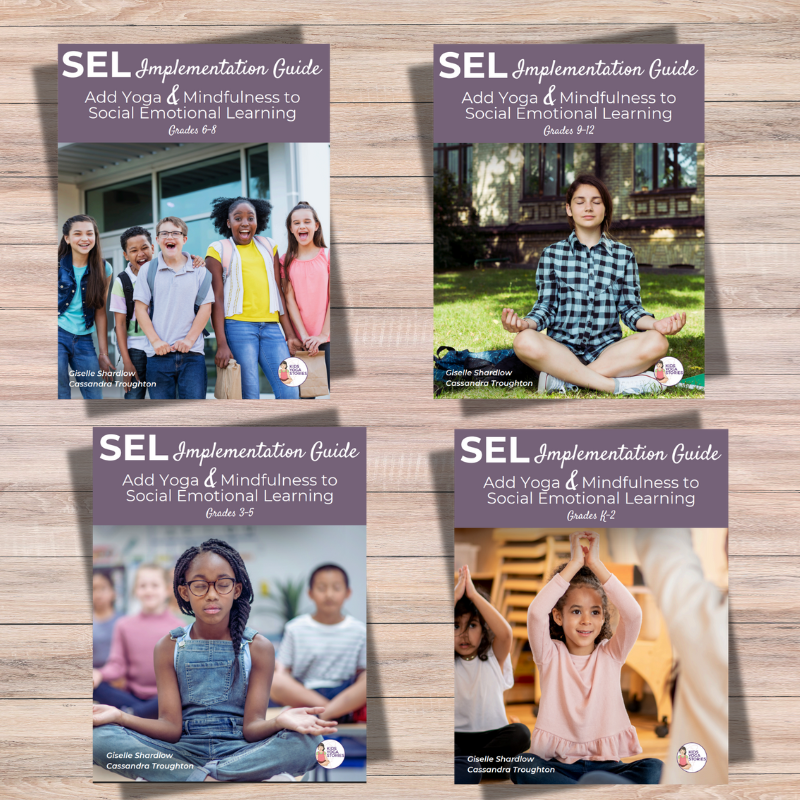
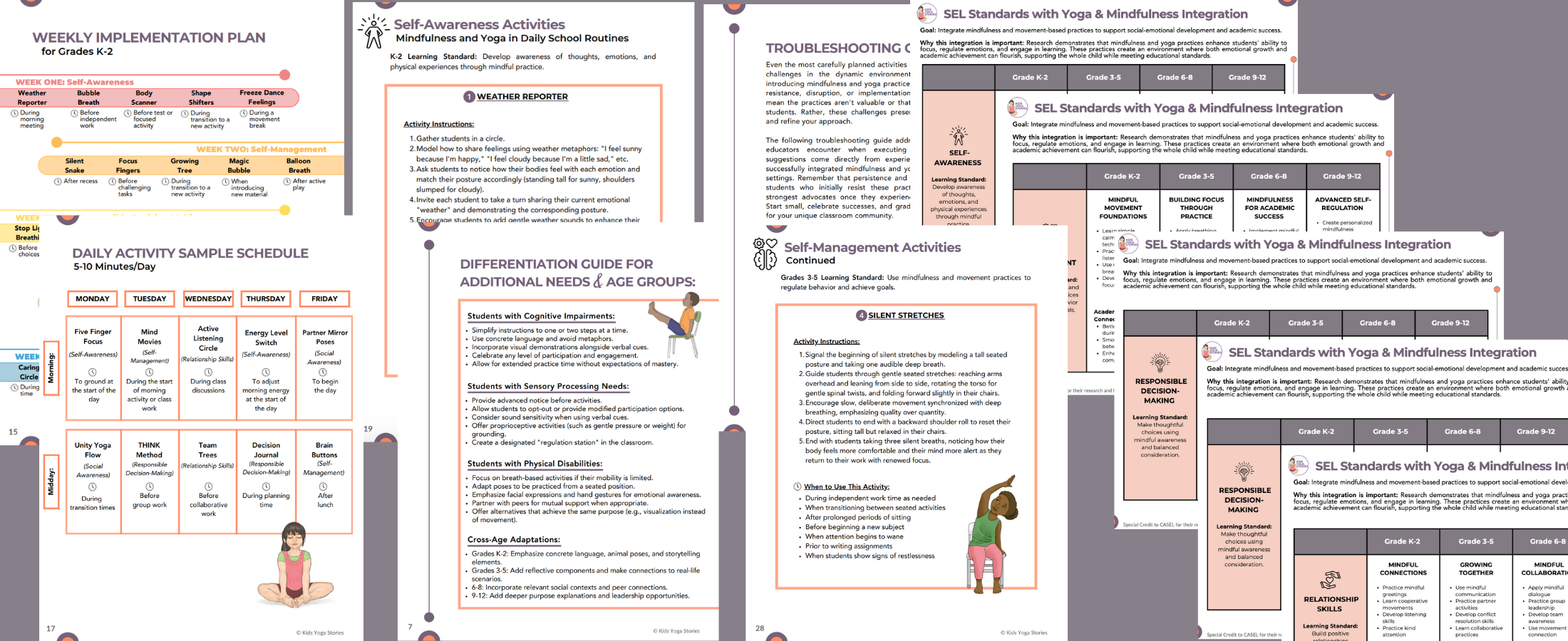
✔️ Comprehensive SEL Implementation Guides (4)
-
Grade-specific tools (4 in total) for all levels: K–2nd, 3rd–5th, 6th–8th,
and 9th–12th (50 pages each!)
-
Weekly implementation plans
-
Daily activity sample schedules by time of day
-
Proposed activities with underlying competencies
-
Tons of exercises with detailed instructions ready to use
-
Troubleshooting guide
-
Activities for each CASEL competency, with step-by-step instructions and optimal times for use
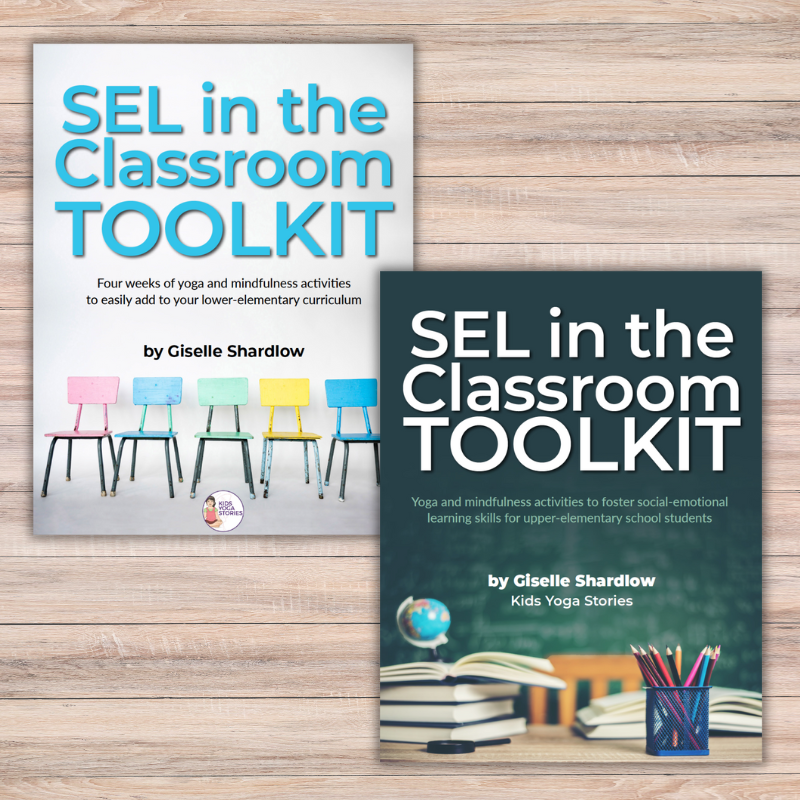
✔️ SEL in the Classroom Toolkits (2)
-
SEL in the Classroom Toolkits: Preschool–2nd Grade
-
SEL in the Classroom Toolkits: 3rd–5th Grade
-
4 weeks each of daily SEL activities
-
Daily themed structure: Breathe Monday, Calm Tuesday, Connect Wednesday, Move Thursday, Play Friday
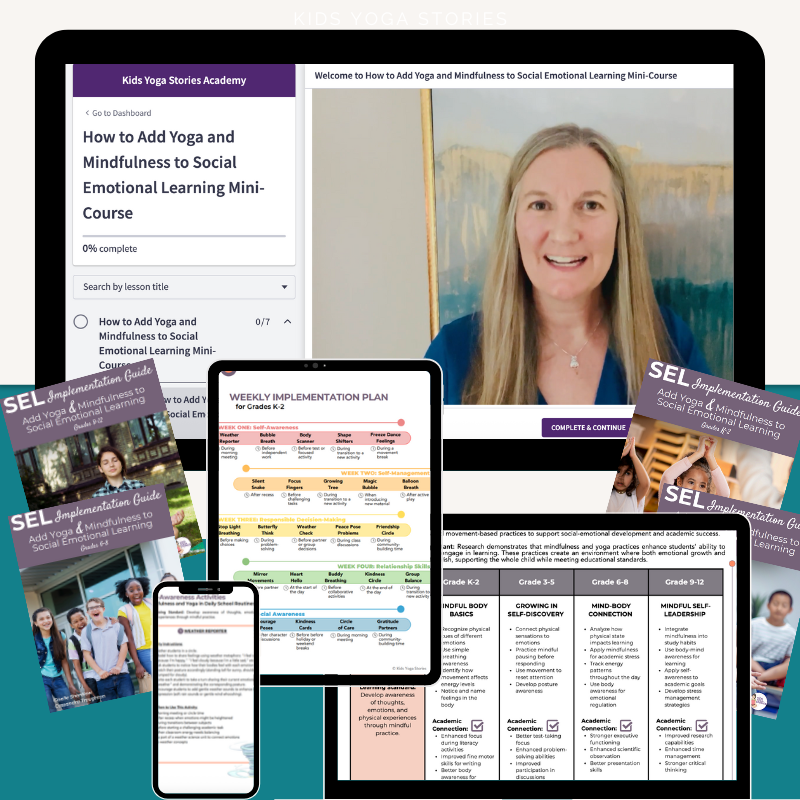
✔️ How to Add Yoga & Mindfulness to SEL Mini-Course
-
Supportive 40-minute video series (3 modules): Help you integrate yoga and mindfulness into your SEL programming.
-
Interactive Workbook: Step-by-step guidance, lesson examples, and planning tools
-
SEL Program Planner: Align with CASEL standards to meet school/district requirements
-
Expert Interviews: Hear from professionals who’ve successfully woven yoga + SEL together
See Everything You'll Receive...
Hint: It's juicy!
Why It Works!
This material is flexible, customizable, and CASEL-aligned.
Whether you’re starting from zero or enhancing a mandated program, you’ll walk away with a concrete, ready-to-use plan that saves you time and builds buy-in with administrators.
Plus, the included SEL Toolkits give you 4 weeks of pre-planned, daily activities you can implement tomorrow.
One Toolkit. Lots of Ways to Use It
You don't need to overhaul your day or create an entirely new SEL program.
Use the toolkit to build a plan from the ground up...
Or, simply reach for it when you need the right activity at the right moment.
START YOUR DAY
→ Choose a quick breathing, movement, or mindfulness activity to help kids settle in and get ready for the day ahead.
SUPPORT A TOUGH MOMENT
→ When big feelings, frustration, or conflict show up, pull an activity that helps kids pause, regulate, and reconnect.
BUILD SEL INTO YOUR WEEK
→ Follow the ready-made weekly plans and daily activities when you want more structure without creating it yourself.
SUPPORT A SPECIFIC SEL SKILL
→ Need to work on self-awareness, emotional regulation, relationships, or another CASEL competency? Find activities designed to support these skills.
ADD MOVEMENT & MINDFULNESS TO WHAT YOU ALREADY DO
→ Already have an SEL program? You don't have to replace it. Use the toolkit to bring breath, movement, yoga, and mindfulness into your existing lessons.
BUILD YOUR OWN SEL PROGRAM
→ Want something more comprehensive? Use the Implementation Guides, planning tools, and Mini-Course together to create a structured approach for your students.
Backed By Research
Here are 7 evidence-based reasons why adding yoga and mindfulness to your classroom routine can support both learning and behavior*:
✔️ Improves Focus and Attention
Mindfulness and movement practices help students tune out distractions and stay engaged—leading to stronger academic performance and more productive work time.
✔️ Reduces Stress and Anxiety
Regular mindfulness activities lower cortisol levels and support emotional balance, helping students feel calmer and more secure during the school day.
✔️ Enhances Emotional Regulation
These practices give kids tools to manage big emotions, pause before reacting, and recover from setbacks—essential for a healthy classroom climate.
✔️ Builds Social-Emotional Skills
Yoga and SEL activities reinforce empathy, compassion, and positive peer connections—key to reducing conflict and building community.
✔️ Supports Self-Regulation and Behavior
Students who participate in daily mindfulness or yoga often show fewer disruptions, improved self-control, and smoother transitions.
✔️ Boosts Body Awareness and Coordination
Yoga poses and movement games support motor development, balance, and spatial awareness—especially helpful for OT/PT goals.
✔️ Primes the Brain for Learning
Short movement or mindfulness breaks reset the nervous system and prepare the brain to return to learning with focus and intention.
Created by an Elementary Educator for Real Classrooms
I know what it’s like to be a primary school teacher with limited time and loads of curriculum to teach in an engaging and effective manner.
I also know what it’s like to be a mom with a massive to-do list and commitments galore.
My daughter is highly sensitive and spirited. We depend on a yoga lifestyle that offers self-regulation tools for life. As I’ve done with my own daughter, I make teaching yoga and mindfulness to kids easy and fun. I’ve done the work so you don’t have to!
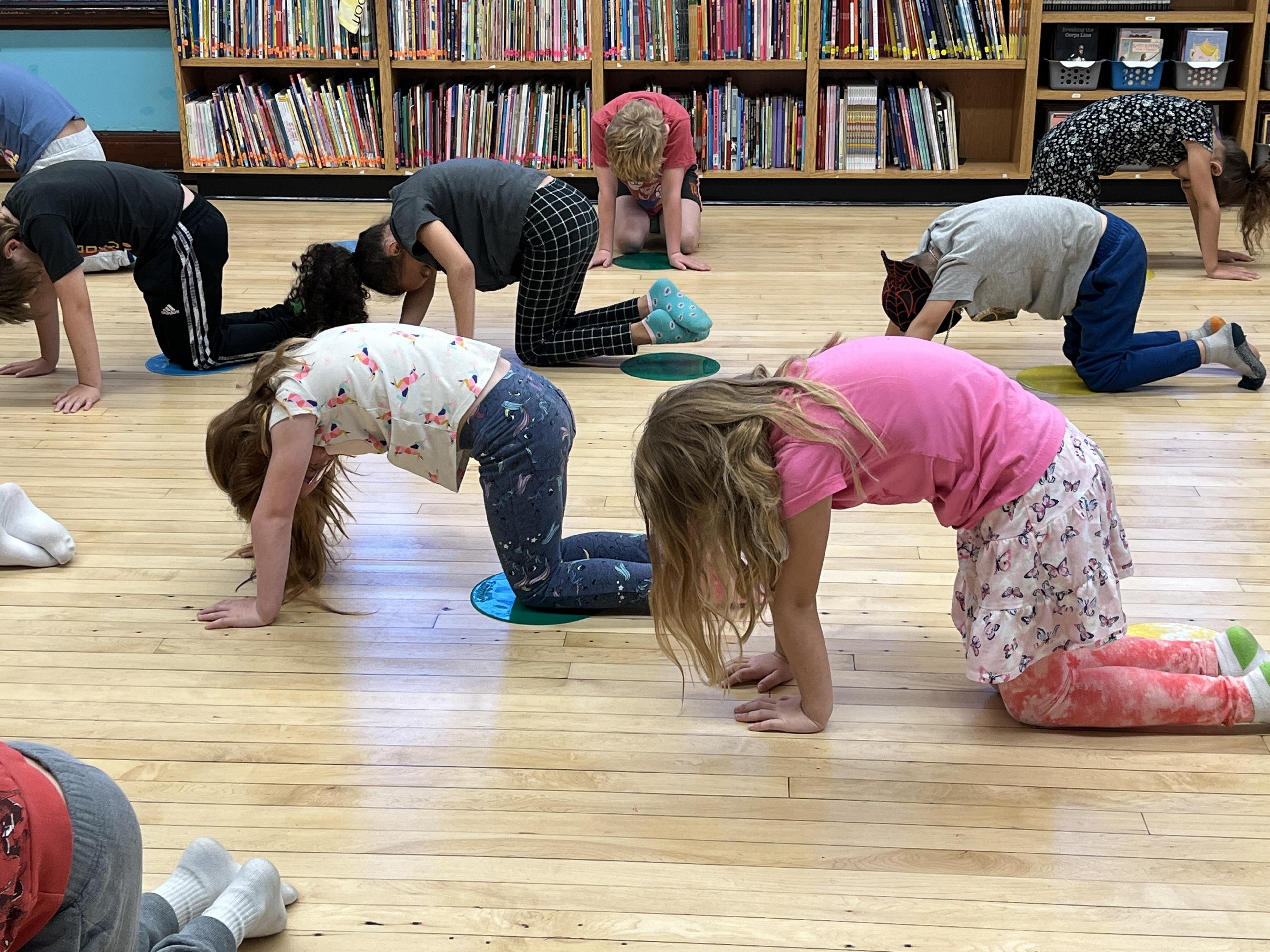
"I am using this program in my Kids Yoga classes and in my own Pre-K class. The ideas from the program are working out really well and the teachers are starting to use it in their classes as well. Thank You for putting it all together in one concise package!!"
N.Davis
Turn Overwhelm Into Action:
A Step-by-Step Path to SEL Success
Try It Risk-Free for 7 Days!
Satisfaction Guaranteed ... Always!
If, for any reason, you decide this resource is not for you, simply reach out, and we will provide a full, prompt refund.
References:
-
Waterford.org. (n.d.). Why mindfulness strengthens social emotional development and learning. https://www.waterford.org/blog/mindfulness-strengthens-social-emotional-development/
-
Costello, E., & Lawler, M. (2014). The impact of mindfulness education on elementary school students. Advances in School Mental Health Promotion, 7(3), 184–195. https://www.ncbi.nlm.nih.gov/pmc/articles/PMC4814783/
-
Meiklejohn, J., Phillips, C., Freedman, M. L., Griffin, M. L., Biegel, G., Roach, A., ... & Saltzman, A. (2012). Benefits of mindfulness training in schools. ERIC. https://files.eric.ed.gov/fulltext/EJ1264988.pdf
-
Mad in America. (2018, May). Yoga improves quality of life for elementary students. https://www.madinamerica.com/2018/05/yoga-improves-quality-life-elementary-students/
-
Tulane University. (2018, May 10). School-based yoga can help children better manage stress and anxiety. https://news.tulane.edu/pr/school-based-yoga-can-help-children-better-manage-stress-and-anxiety
-
Bazzano, A. N., Anderson, C. E., Hylton, C., & Gustat, J. (2018). Effect of mindfulness and yoga on quality of life for elementary school students and teachers: Results of a randomized controlled school-based study. Psychology Research and Behavior Management, 11, 81–89. https://www.ncbi.nlm.nih.gov/pmc/articles/PMC5948868/
-
Hülsheger, U. R., & Fehrmann, C. (2023). The effects of a mindfulness-based training in an elementary school. Mindfulness. https://www.ncbi.nlm.nih.gov/pmc/articles/PMC9996056/
-
Child Mind Institute. (n.d.). How can we help kids with self-regulation? https://childmind.org/article/can-help-kids-self-regulation/
-
Razza, R. A., Bergen-Cico, D., & Raymond, K. (2015). Yoga and mindfulness for social-emotional development and resilience in early childhood. Psychology Research and Behavior Management, 8, 219–232. https://www.ncbi.nlm.nih.gov/pmc/articles/PMC9873466/
-
Aim Higher ABA. (n.d.). The benefits of yoga and mindfulness for children with autism. https://aimhigheraba.com/the-benefits-of-yoga-and-mindfulness-for-children-with-autism/
-
Thomas, L., & Munoz, L. C. (2020). System-wide school mindfulness: Addressing elementary students’ social and emotional needs. Frontiers in Education, 5, 591271. https://www.frontiersin.org/articles/10.3389/feduc.2020.591271/full
-
Black, D. S., & Fernando, R. (2014). Mindfulness training and classroom behavior among lower-income and ethnic minority elementary school children. Journal of Child and Family Studies, 23, 1242–1246. https://www.ncbi.nlm.nih.gov/pmc/articles/PMC4323355/
-
Wehner, D. M. (2019). Yoga and mindfulness in the self-contained classroom (Master’s thesis, Rowan University). https://rdw.rowan.edu/cgi/viewcontent.cgi?article=1083&context=etd
-
Wang, D., & Wang, Y. (2021). Effects of a 12-weeks yoga intervention on motor and cognitive development in preschool children. Frontiers in Pediatrics, 9, 718343. https://www.ncbi.nlm.nih.gov/pmc/articles/PMC8640661/
-
Wang, D., & Wang, Y. (2021). Effects of a 12-weeks yoga intervention on motor and cognitive development in preschool children. PubMed. https://pubmed.ncbi.nlm.nih.gov/34926359/
-
Fraser. (n.d.). Teaching children mindfulness can help them regulate emotions. https://fraser.org/resources/blog/teaching-children-mindfulness-can-help-them-regulate-emotions/
-
Harvard Graduate School of Education. (n.d.). Making time for mindfulness. https://www.gse.harvard.edu/ideas/usable-knowledge/16-07/making-time-mindfulness
-
Boyte, L. (2021). The impact of mindfulness-based yoga interventions on elementary students (Honors thesis, University of Mississippi). https://egrove.olemiss.edu/context/hon_thes/article/2801/
-
Yamada, M., Fujiwara, T., & Kawachi, I. (2021). An exploratory cluster-randomized controlled trial on mindfulness for school refusal. Frontiers in Human Neuroscience, 15, 620300. https://www.frontiersin.org/articles/10.3389/fnhum.2021.620300/full
-
Waterford.org. (n.d.). 51 mindfulness activities for kids in the classroom. https://www.waterford.org/resources/mindfulness-activities-for-kids-in-the-classroom/
©2026 Kids Yoga Stories. All rights reserved
